
Benewah Projected vs Actual Release
A scheduled field describes what may happen if the current judgment, credits, holds, and agency decisions remain in place. Actual release is a completed custody event. Idaho separates several dates that are often collapsed into the phrase “projected release date,” and none should be presented as a guarantee.
A pretrial person in Benewah County Jail generally has no calculated state-prison exit date. Bond can authorize release once conditions are met, but a hold, warrant, transfer order, or later court action may control the result. For a sentenced county prisoner, the judgment, jail credit, holds, and jail processing govern. For an IDOC prisoner, the sentence calculation and Commission record supply the relevant milestones.
Find a Benewah County Projected Date
Begin with the physical custodian. Benewah County Jail records and a state IDOC record describe different custody systems. The Benewah County released-inmate search explains how to identify that system when the person may already be out.
- For county custody, call Benewah County Jail and ask whether the person remains held, has a release order pending, or was transferred. Use the full name and booking or case number.
- Open Idaho iCourt and locate the Benewah judgment, bond order, dismissal, amended order, or other docket event that supplies the legal basis.
- For state custody, search the IDOC Resident/Client Search by name or IDOC number, then compare identifiers and sentencing county.
- Read each date by its exact label. Do not rename parole eligibility or a hearing date as physical release.
- Check Commission actions if parole is involved. A grant may contain a tentative date, while a denial or pass changes the expected path.
- If the calculation appears wrong, compare the judgment and amendments with IDOC's detail and request the sentence computation from IDOC Sentencing Records.
A Benewah sentencing-county label identifies the case source, not the person's present prison, jail, or release destination.
Idaho Fixed Terms, Not 85 Percent
Idaho Code § 19-2513 requires the sentencing court to state a fixed minimum period and any later indeterminate period. During the fixed portion, the person generally is not eligible for parole or discharge and does not receive an ordinary good-conduct reduction. The common online shortcut that “truth in sentencing means 85 percent” is not Idaho's rule.
The official Idaho Legislature statute page supplies the fixed and indeterminate sentence text.
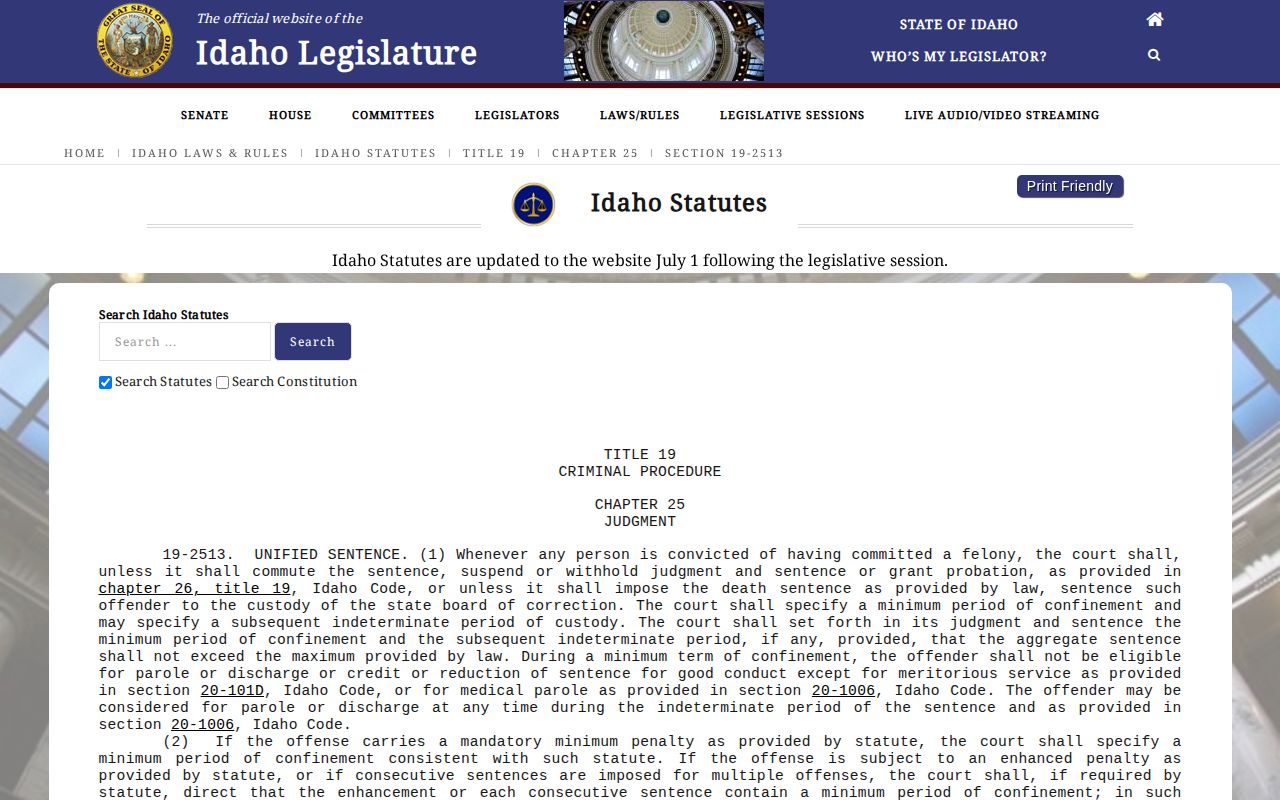
The statute is the sound starting point for reading an IDOC date, rather than applying a generic percentage borrowed from another state.
After the fixed term, the indeterminate portion begins and parole may be considered. Eligibility is not a right to release. The Commission can grant release on or after eligibility, deny or pass the case, or keep the person confined through the lawful sentence. Mandatory minimums, concurrent or consecutive judgments, jail credit, retained jurisdiction, parole forfeiture, and later court orders must be read from the real case.
IDOC Sentencing Records reviews judgments, calculates sentences, applies jail and retained-jurisdiction credit, processes parole forfeiture, and maintains sentence data. It is the proper agency unit for a disputed state calculation. Benewah County Jail cannot declare an IDOC sentence satisfied, and IDOC does not own an ordinary county-only release record.
What Changes Benewah Release Timing
A date can move because the underlying legal or administrative facts changed, or because a public field was only conditional from the start. The agency holding the person should identify which factor controls.
| Factor | Effect on the date | Best record |
|---|---|---|
| Court order or amendment | May alter the sentence, bond, credit, or authority to hold | Signed judgment and iCourt docket |
| Jail or retained-jurisdiction credit | Changes IDOC's calculation when legally applicable | IDOC sentence computation |
| Consecutive or concurrent cases | Changes which term controls and when it begins | Judgments plus IDOC calculation |
| Detainer, warrant, or transfer | May prevent community release even when one custody ends | Source and receiving agency records |
| Parole action | A grant may set a conditional date; denial or pass extends confinement | Commission Notice of Action |
| Programming and parole plan | Can delay or defeat a tentative parole date | Commission and IDOC confirmation |
| Extraordinary statutory reduction | A narrow discretionary award may reduce an eligible term | IDOC calculation and statutory action |
Confirm a Benewah County Release
The Commission hearing schedule proves a hearing was planned. A Notice of Action Taken proves the Commission acted. A tentative date proves conditional intent. IDOC's later “In community” or “Released to Supervision” detail is stronger evidence that community placement occurred, while a dated “Discharged” status shows sentence satisfaction.
For a county jail event, ask the sheriff for the booking and release record, including release date and time, release category, and receiving agency. That last field matters because transfer to IDOC, another jail, ICE, or another sovereign is not community release. For state custody, ask IDOC to confirm the computed dates and current status.
Registering for a named person's custody alert through the VINELink Inmate Search can provide timely notice. Treat the alert as a custody change and confirm the destination with the source agency. VINE is not the sentence calculator or the legal judgment.
Idaho's Distinct Release-Date Fields
IDOC does not publish one universal field called “Projected Release Date.” Sentence Satisfaction Date is the scheduled endpoint of the controlling sentence. Parole Eligibility Date marks when discretionary consideration may begin. Next Parole Hearing Date marks a proceeding, and a Tentative Parole Date reflects a conditional Commission grant.
| Idaho field | What it proves | What it does not prove |
|---|---|---|
| Sentence Satisfaction Date | IDOC's scheduled sentence endpoint | A promised door-release date |
| Parole Eligibility Date | Earliest controlling parole consideration point | A grant or release |
| Next Parole Hearing Date | A planned Commission event | The outcome |
| Tentative Parole Date | Conditional Commission intent | Completed release |
| Released to Supervision | Community placement under supervision | Final discharge |
| Discharged with date | Sentence satisfaction and end of IDOC jurisdiction | The earlier physical prison-exit time |
The Commission warns that programming and an approved parole plan must be complete before actual release can be finalized. Read the fields as a sequence, not interchangeable labels.
Benewah Release and Meritorious Service
Idaho Code § 20-101D creates a narrow exception for extraordinary meritorious service, such as specified heroism, saving life, preventing major property loss during riot, or preventing escape. For eligible non-life terms and applicable offense dates, the director may award a limited reduction of up to 15 days per month sentenced under the statute.
IDAPA 06.01.01.136 says there is no right or entitlement to the award. It may be withdrawn for serious misconduct, escape, or a new crime. This is not routine good time and must not be entered into a public “release calculator” as expected credit.
For county custody, no official Benewah policy was found for local good time, weekend adjustments, or release time of day. Do not import the state-prison framework into a county sentence or invent a Friday-release rule. Obtain the court order and ask the jail how it applies that order.